Choosing a steel light pole is not simply a question of height or price. The right design must suit the site, the lighting equipment, and local weather conditions. A coastal road may need stronger corrosion protection than a sheltered parking area. An open industrial yard may require a taller pole with carefully checked wind loads. Details matter.
This guide introduces common options for global buyers, including tapered, octagonal, high-mast, decorative, and solar-ready poles. Each type serves different needs, and names or standard features can vary between suppliers. Buyers should compare pole dimensions, steel grade, protective coating, base plate, anchor bolts, and luminaire mounting details. Ask for drawings and load information, not just a catalog image. A polished specification is not always a complete one.
There is no single best steel light pole for every project. Local engineering requirements, transport limits, installation access, and maintenance plans can change the decision. Confirm applicable standards with qualified project professionals, since requirements differ by location and application. This overview is a starting point, not a substitute for project-specific design review. Some choices look obvious on paper, then prove awkward during installation. Careful comparison helps buyers spot those gaps before ordering and select a solution that is practical, durable, and suited to its intended use.
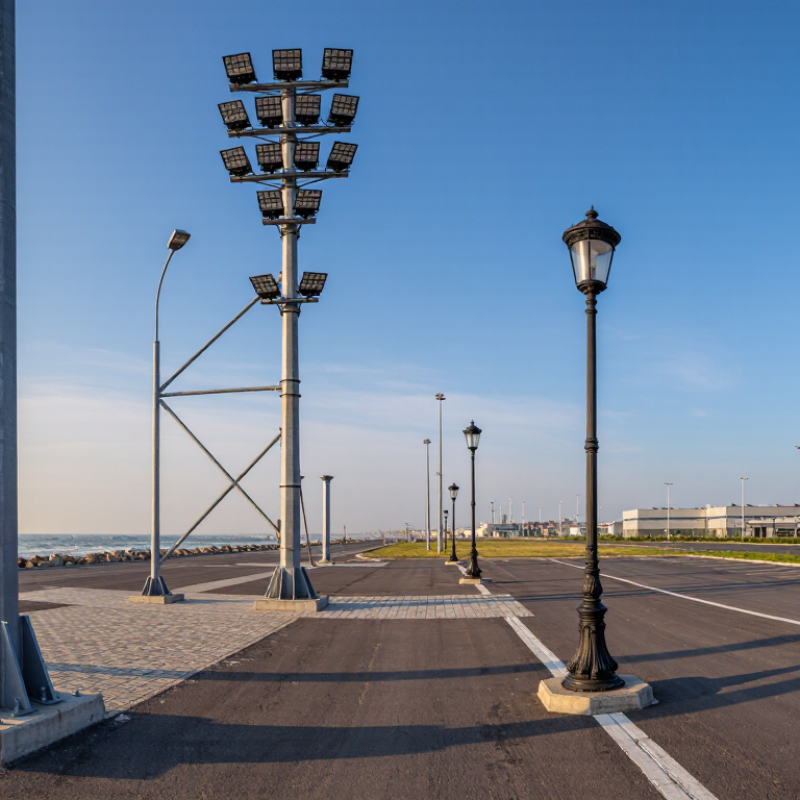
Steel light poles are not one standard shape with different labels. Their geometry affects stiffness, appearance, fabrication, and installation. Tapered poles narrow toward the top, reducing visual bulk while keeping a clean roadside profile. They suit many conventional luminaires, but base plates and anchor-bolt layouts must match project drawings. Details matter.
Octagonal poles have eight flat faces, which can provide practical surfaces for brackets and access features. Buyers should compare wall thickness, section length, weld quality, and coating specifications rather than judging strength by shape alone.
High-mast poles illuminate broad areas such as ports, interchanges, and sports grounds. Their tall shafts may use lowering systems, so maintenance access, wind loads, foundations, and servicing need early review. Plan early.
Decorative steel poles bring lighting into streets, plazas, and heritage-style developments through shaped shafts, arms, bases, or ornamental details. These features can make cleaning and recoating harder, especially around joints and trim. Request dimensional drawings, material and coating records, load assumptions, and inspection guidance. Match each pole to its luminaire, soil conditions, and site exposure, not just a catalogue image. The most attractive option may not be the easiest to maintain; that trade-off deserves discussion before purchase.

For road and neighborhood lighting, steel poles from 3 to 12 m suit sidewalks, residential streets, parking bays, and local roads. A 3–6 m pole can keep light close to pedestrian paths, while 8–12 m poles commonly serve wider streets and junctions. The right height depends on road width, fixture output, spacing, and required uniformity—not height alone. Small is not simple.
A 20–50 m high mast can illuminate broad spaces such as freight yards, large parking areas, industrial sites, and sports grounds. Several floodlights mounted on one mast may cover a wide area, but beam direction matters. Poor aiming can create dark patches or glare for drivers and nearby properties. Taller structures also face greater wind forces, so foundation design, soil conditions, and local wind data need careful review.
Maintenance deserves attention early. At 3–12 m, crews may be able to service luminaires with standard access equipment, depending on the site. High masts may use lowering systems or specialist lifting equipment, adding cost and planning requirements. A high mast is not automatically the economical choice; fewer poles can mean more demanding foundations and servicing. It is easy to focus on reach and overlook access.
2026 Top Steel Light Pole Types for Global Buyers
Steel Grades and Strength: S355 Provides 355 MPa Yield Strength at ≤16 mm
For steel light poles, grade selection affects more than a specification sheet. Under applicable standards, S355 has a minimum yield strength of 355 MPa for thicknesses up to 16 mm. The required value may be lower for thicker products, so check the relevant standard and mill certificate. This difference matters when assessing tapered shafts, access-door openings, and base plates. A stronger grade can support an efficient design, but it cannot replace structural calculations. Site wind loads still matter.
Pole performance also depends on geometry, weld quality, and connection details. Verify wall thickness along the shaft, anchor-bolt layout, and stresses around access doors. For corrosive environments, specify suitable protection and inspect coating coverage after fabrication. Certificates should identify the steel grade, product thickness, and test results. Paperwork is not glamorous. It helps prevent costly assumptions. Added strength cannot fix poor detailing.
Tip: Compare design loads with actual site conditions, including wind exposure and mounted accessories. Request thickness-specific certificates, not just a general grade statement. Check that the stated S355 strength applies to the ordered thickness. Early drawings can be incomplete, so leave time to review critical dimensions.
Minimum yield strength for common structural steel grades at thicknesses up to 16 mm. S355 provides a minimum yield strength of 355 MPa.
Values shown are nominal minimum yield strengths for the listed grades at thicknesses ≤16 mm, based on EN 10025-2. Actual pole performance depends on design, dimensions, fabrication, and applicable standards.
A steel light pole is not selected by height alone. Its governing load depends on local wind speed, terrain exposure, topography, and attachments such as luminaires or signs. ASCE/SEI 7-22 assigns mapped wind speeds by risk category; for example, its Risk Category II and III maps use 700-year and 1,700-year mean recurrence intervals. These are design inputs, not forecasts of when a storm will occur. Small differences matter. A coastal site, an exposed ridge, and a sheltered urban street can require different checks, even when the poles look identical.
For European projects, EN 40-3-1:2013 sets the basis for calculating wind actions on lighting columns; EN 40-3-3:2013 addresses structural verification. Use the standard adopted for the project jurisdiction, and do not mix wind assumptions casually. Wind pressure on the shaft creates a base moment that must be transferred through the anchor bolts and foundation. Check soil strength, groundwater, frost depth, and concrete dimensions against site investigations. A tidy calculation can still hide weak soil data. That is easy to overlook. Record the assumed terrain, pole configuration, and luminaire projected area, then have the design reviewed against the actual site conditions.
For steel light poles, corrosion protection starts before the pole reaches the galvanizing bath. Specify hot-dip galvanizing to ISO 1461, which defines coating requirements and test methods for fabricated iron and steel articles. The NACE International IMPACT study estimated corrosion costs at US$2.5 trillion globally, or 3.4% of global GDP. That figure covers many industries, not light poles alone, but it shows why coating quality matters. Small details matter.
Ask suppliers to confirm coating inspection records and the specified steel-thickness category. Pole shafts, base plates, welds, and access-door edges all need attention; poorly planned vent and drain openings can leave areas inadequately coated. Not just thickness. ISO 1461 does not promise a fixed service life. Exposure varies with coastal salt, industrial pollution, road spray, and maintenance. A pole beside a salted winter road may weather differently from one in a dry inland district. Specify the expected environment, inspect the coating after transport, and repair handling damage using an agreed procedure. One practical oversight is assuming a certificate alone proves every surface is protected. Review the design and inspection evidence together.
